Thursday, August 2, 2012

1,000th Lighthouse and Trip To France


Cape Bonavista Lighthouse

We are back in Nova Scotia after traveling almost 8 weeks in Newfoundland.  We enjoyed our visit there so much that we have made this one of our premier places to revisit (and have started to make plans to come back in 3 or 4 years).  Here are some of the highlights from our last few weeks in Newfoundland:
  • We reached a milestone on a foggy day on the Burin Peninsula (south central Newfoundland) when we took photos of the Middle Head lighthouse (near St. Lawrence).  This was our 1,000th lighthouse photographed so far.  In order to reach it, we had to drive down a pretty rough narrow gravel road for over 2 miles and the lighthouse was not all that impressive – but it still had that mystique that draws us toward these lights in the night.  Instead of celebrating very long, we drove back the gravel road and headed to the next lighthouse on our way to our new goal of 1,250.  This will probably be our last realistic goal as we are running out of lighthouses to see in the USA and Canada.
  • While on the Burin Peninsula we took a day trip to France.  You might say ‘How is that possible?’  Well, just a few miles off the coast of Newfoundland are small islands named Saint-Pierre and Miquelon.  This is a self-governing territorial overseas collectivity of France and it is the only remnant of the former colonial empire of New France that remains under French control.  Two of the islands are permanently inhabited (Saint-Pierre has 6,000 and Miquleon has 600 permanent residents).  After a passenger only ferry ride and going thru customs you step into another world.   Some of the things different are: most of the cars are small European ones; all signs are in French; the currency is the Euro; they are on a different time zone (same as Greenland, the Falkland Islands, & Argentina);  almost everything closes for lunch from 12 noon to 1:30 (except restaurants); the police (gendarmes) come from France with their families for 3 years (free housing included); and (from what we understand), the French spoken here is Parisian and not the Quebec Canadian version.  On the day that we went, it was so foggy that no one got off our tour bus at the view points that we stopped at, but we did manage to take photos of lighthouses when the fog lifted for a few minutes.
  • We spent almost 2 weeks in St. John’s in Pippy Park which was very convenient right in town.  While there we took 4 day trips to the 4 mini peninsulas of the Avalon area (the southeastern part of Newfoundland) and visited Cape Race where the first SOS signal from the Titanic was received; the Cape St. Mary’s Seabird Ecological Reserve; and Hawthorne Cottage (the home of Captain Bob Bartlett – world famous Arctic Explorer - he was the unsung hero in Perry's expidition to the North Pole).  Of course, we took photos of multiple great lighthouses along the way. 
  • In St. John’s we visited the provincial government’s Assembly room in the Confederation Building.  One of the things that we like to do is take tours of the center of the government in each of the provinces & territories.  We have found this to be an excellent way to learn about the unique history of each one.  Some have a parliament (with 2 houses), some have only an Assembly, and in the Northwest Territories the 12 delegates sit around a table.
  • The 2 outstanding places we really enjoyed in St. John’s were to go up to the top of Signal Hill (where you can get great views of the city, the harbour, and the ocean) and the beautiful new ‘The Rooms’ (Provincial Archives, art gallery and museum).
  • While at the Iceberg Festival in St. Anthony in early June, we so enjoyed an evening listening to ‘Ennis’ (a Newfoundland sisters singing group) that we checked to see where they were performing again.  We were fortunate to get tickets to hear them again in Tors Cove (near St. John’s).  What made this so special was that there were only 40 tickets available for this evening.  It was a family affair with their parents and other relatives there mixed in the group.  There was another couple there from Texas that had flown in to see Ennis and to go swimming with the whales (which you can do here).  I think that the four of us from Texas were the only non-Newfies there.  What a wonderful evening we had.  We called this our bookends event since we first heard them in the far NW corner of Newfoundland & then here on almost the far SE corner.
  • All in all, we enjoyed exceptional weather (except our foggy trip on the Burin Peninsula and to Saint Pierre and Miquelon).  We had been told to expect foggy overcast days in St. John’s but were blessed with many bright sunny days.  The temperatures were also quite comfortable and cool.   It was sort of humorous to us when the temperature reached 85 degrees Fahrenheit one day and we overheard some Newfies say that it was ‘sweltering’.
As we continue our journey in Nova Scotia, we are now looking forward to seeing Nova Scotia (most of which we have not visited before, except for the Cape Breton Island part).  We have been asked so many times ‘Have you been to the Peggy’s Cove lighthouse near Halifax? (and we have not been) that we have to go there this time.  Since there are over 100 lighthouses in Nova Scotia (80 of which are accessible that we have not seen), we will be kept busy. 
Hope this update finds you all doing well.
A view of the tickle (an inlet) at Newtown.  The yellow buildings on the left are part of the historic Barbour Living Heritage Village (place where a merchant family in the sealing and fishing industry in rural Newfoundland lived).  One of the Barbours was the captain of a sailing ship adrift in the Atlantic for 48 days and managed to finally make it to Scotland.

Atlantic Puffins in the colony at Elliston (near Bonavista).  You can walk out to get a pretty good view of the puffins there.

Cape Spear lighthouse (old one) - there is a newer one close by.  This is the easternmost point in North America (however, if you want to be technical and include Greenland as part of North America, then it is further east - and to be really techical and use true longitude, there is an island in Alaska that is further east).

Northen Gannet perched on a rock at the rookery in Cape St. Mary's Ecological Reserve.  Note how flexible it's web feet are clinging to the rock edge.

Here it is.  Our 1000th lighthouse.  Middle Head lighthouse as seen on a foggy day.

New Terry Fox Memorial in St. John's.  This is where in 1980, Terry Fox (after losing one leg to cancer) started his Marathon of Hope run across Canada to raise funds for cancer research.  He made it to Thunder Bay, Ontario (on northern shore of Lake Superior) where his cancer returned and he had to stop.  He so inspired the people of Canada that more than 600 million dollars have been raised in Terry Fox runs since his great feat.  We wanted to visit this memorial since we had visited the Terry Fox Memorial in Thunder Bay years ago.

Heart's Content lighthouse.  Notes: Heart's Content is a community adjacent to the communities of Heart's Desire and Heart's Delight. Heart's Content was the major transatlantic telegraph cable terminus in North America (connected to Ireland).

Ennis - Maureen Ennis (in the middle) is the main composer and singer - Karen Ennis (on the right) is the storyteller, singer, and tin whisle player - Mark Murphy (on left) co-composes some songs and helps accompany the group.


Fort Amherst (fort and lighthouse) - as viewed from the top of Signal Hill in St. John's

Our best campsite in Newfoundland - overlooking the ocean in La Scie (which means The Saw, because of the jagged coastline that looks like the teeth of a saw)


Some of the colorful houses in St. John's.  They were painted this way initially to help fishermen find the harbour in the fog.

A model community set up beside a house in Greenspond - with the Puffin Island lighthouse in the distance
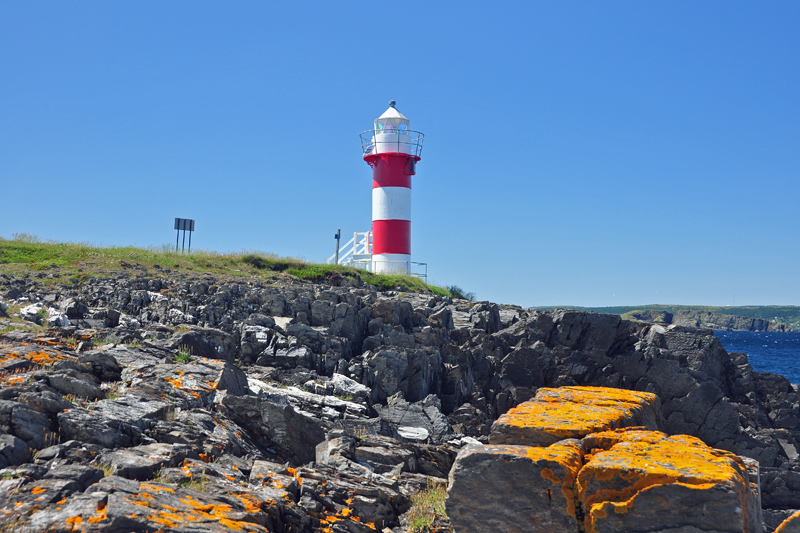
Orange growth on rocks in front of the Green Point lighthouse near Bay Roberts

One of many wild irises found along trails (this one on Cape Bonavista).

A large number of the homes have a nice front door, but no steps or porch.  It is required for an extra escape door.  This door is commonly referred to as the 'Mothe-In-Law' door.

Newfoundland Wolf (became extinct in the 1930's).  This last known specimen was in 'The Rooms' musuem in St. John's

Wednesday, July 4, 2012

Icebergs, Gremlins, and The Big Rock

Map of Newfoundland (from postcard).  Note: Labrador is not to scale.

We have really enjoyed our travels the past 6 weeks (especially here in Newfoundland) and are now on our way to St. John’s on the east coast.  We have been here once before (back in 2006 when we drove across Labrador and then down the west coast of Newfoundland – but we did not see much since it was at the end of the season in early October and everything was closing up).  This year’s trip had been our last planned one here and we had set aside 7 weeks to see it – but this is such a special place that we are already planning to come back here in a couple of years.
Since Newfoundland is mostly unknown in the states, here are a few facts:
  • It is part of the Canadian province called Newfoundland and Labrador (NL).  Labrador is part of the mainland of Canada and Newfoundland is a very big island off the coast of Labrador – it is almost as big as the state of Ohio and the driving distance from the farthest little community in the northwest (Quirpon – pronounced kar-poon) to Cape Race in the southeast is 1,138 kilometers (711 miles).
  • To get to the island you sail from Nova Scotia on some of the largest ice-breaking ferries in the world (1,200 passengers and 350 cars) - either to Channel-Port aux Basques in the southwest (~110 miles (5 ½ hours)) or to Argentia in the southeast (~325 miles (14 hours)).  The cost one way to take our 50 foot long RV (truck + 5th wheel) is about $375 on the short route and $850 on the long route.
  • Nova Scotia is on Atlantic Time (1 hour ahead of Eastern Time) and Newfoundland is on their own time zone – a half hour ahead of Atlantic Time.
  • It is very rocky here (and is often referred to as The Big Rock).  It is also hilly in many places with mountains on the west coast that are the northernmost part of the Appalachian Mountains.  The Long Range Mountains in Gros Morne National Park are the oldest in the world.
  • There are about 500,000 people living here on the island and about half live in the Avalon area which surrounds St. John’s (the capital).
  • Life in Newfoundland has been (and still is) based upon fishing.  All around the island are countless little fishing communities nestled around protected harbours.
  •  A moratorium on cod fishing was issued in 1992 and many of the fishing communities are having a really tough time economically.   To give you an idea of the economic conditions  (not only in small communities, but even in larger ones), one of the rental car agents (about 25 years old) said that 85 out of his high school graduating class of 180 are now working in Alberta in the oil industry.
  • There are about 10,000 moose here and we have seen about 10-15 of them so far.  While driving one must always be looking out for them, since hitting one (over 1,000 pounds) can be devastating.
  • There are very few roads in the interior – the main one from Channel Port aux Basques to St. John’s is Hwy 1 – Trans Canada Highway – referred to as TCH.  This is a very good highway with most of it being limited access and two-lane with many intermittent passing zones.  Once you get on some of the side roads, however,  it is a different story – many potholes and multiple patches and dips (heaves) in places – so driving can be fun (looking for moose, potholes, and the beautiful scenery all at the same time).
  • In all of our travels in Canada, the people here in the Atlantic Maritimes (especially in Newfoundland) are the most friendly that we have met.  A lot of people found out how great the people are during the 9/11 disaster when people in the small community of Gander (population of about 10,000) and the surrounding communities volunteered their time, food, homes, etc. out of the kindness of their hearts to help the 6,595 stranded passengers and crews of the 38 planes that were diverted here for a few days.
Before heading for Newfoundland, we spent a week in the Boston area parked in the driveway of fellow New Horizons 5th wheel owners in Lexington.   While there, we took photos of numerous lighthouses; visited with one of Jan’s schoolmates from childhood in Richmond, Indiana; went to some of the numerous historic sites; visited the John F. Kennedy birthplace and Presidential Library and Museum; and also enjoyed seeing some wildlife in a couple of National Wildlife Refuges.  There is so much to see and do here that we plan to spend a few more days on our way back in September.
After spending 2 days at the Seashore Trolley Museum in Kennebunkport, Maine we headed for Canada.  This time the customs agents asked us to open all of our truck and trailer compartments and then they searched thru things for about 15 minutes, but of course, did not find anything.  After clearing customs and about 40 miles before reaching the large city of Moncton, the gremlins that had left us alone for well over a year decided to visit us again.  One of the trailer tires blew out caused by the wheel bearings disintegrating and the resultant wobbling tire rubbing against the bracket holding the brake calipers.  There was no way to have someone tow us in (we would have been loaded onto a low bed truck and would have been too tall to go under the overpasses in front and behind us).  So, we took off the bad tire and drove the last 40 miles very carefully on 3 trailer tires into a campground in Moncton.  The next day, Jan removed the bad bearings, had new ones pressed into the wheel hub, got a new tire, and we were back on our way.  Fortunately, we had spare bearings with us.
 After a quick drive thru Nova Scotia and a very good ferry ride (short route), we arrived in Newfoundland and toured the southwest part of the island (mainly taking photos of lighthouses).   We even rented a car and drove to Burgeo on the south coast and took a small ferry to the small remote island of Ramea to see the lighthouse there and also spend the night at a B&B.  The return ferry to the mainland in the morning had electrical problems, but fortunately was fixed in time for the afternoon trip (otherwise we would have had to spend 2 extra nights on the island).
Then it was on to the far northwest part of Newfoundland to the Iceberg Festival in St. Anthony.  While there, we saw some icebergs, enjoyed the concert given by Ennis (a Newfoundland sister music group), attended a couple of ‘kitchen parties’ (an evening of music including visitations by mummers [veiled people in outrageous costumes]), and got to meet 2 big Newfoundland dogs.   In addition, we visited L’Anse aux Meadows National Historic Site – the only authenticated Viking landing location in North America.  And then we finally fulfilled one of our bucket list items and spent our first night in a lightkeepers house at the lighthouse on the farthest north point in Newfoundland (the Cape Bauld lighthouse Inn on Quirpon Island).   What a delightful evening we had visiting with the other guests and the staff at this isolated lighthouse!
Then going back down the west coast we visited the beautiful Gros Morne National Park and hiked in over 1 1/2 miles on a fabulous sunny day to take a boat ride thru the very scenic Western Brook Pond fjord with its high cliff sides.  This was a salt water fjord, but glaciers 10,000 years ago blocked the entrance and now it is a fresh water pond.  Side notes: a lot of the lakes up here are called ‘ponds’; bodies of water smaller than bays (but larger than coves) are called ‘bights’; and narrow bodies of water between 2 islands or an island and the mainland are called ‘tickles’ (probably named that because crossing one of these when the tides are rushing in or out can be a ticklish proposition).
One of the long side trips we made in a rental car was driving down frpm Grand Falls-Windsor to the central south coast to Harbour Breton to photo some lighthouses.  We enjoyed the beautiful scenery (including some great fjords), but did not like some of the roads (especially one gravel road that we should not have gone on (but made it back OK)).  After this trip we drove up to Twillingate on the north shore and spent a few days there.  While there we enjoyed a very funny dinner theatre production and 2 nights of really great music; took photos of lighthouses; and rode a ferry over to Fogo Island for a day to visit the communities of Fogo, Seldom, & Tilting.  Twillingate is definitely one of destinations on our return trip in a couple of years.
We are already starting to feel like we don’t want to leave the Big Rock even though we still have 3 more weeks to go before heading to Nova Scotia.  To extend the time here and see more places, we have decided to drive the 500 miles from the St. John’s area back to Channel Port aux Basques and take the short ferry ride (instead of the long ride) back to Nova Scotia.
So far, the weather has been great (lots of sunny days) and cool - in St. Anthony it would drop to 4 (upper 30’s F) at night and some days would not rise above 10 (50 F).  The hottest it has been so far has been around 27 (80 F).   However, our great weather may be changing now to a lot of cloudy, rainy days, with lots of fog as we near the eastern shores (St. John’s is noted for fog).  We really wish that we could send of the cool weather from up here down to all of you that are trying to withstand such high temps.
Hope this update finds you all doing well.
Cape Bauld lighthouse - on Quirpon Island
Iceberg along west coast of Newfoundland
Large iceberg (it was estimated that about 130 feet of it is below the water line).  This is one that we went around on a boat ride.
Moose near St. Anthony
Eastern Point lighthouse - near Gloucester - near Boston
Boston Harbor lighthouse - Oldest lighthouse in the US, however, it was later reconstructed.  The Sandy Hook lighthouse in New Jersey is the oldest one that is still standing as originally constructed.
Scituate lighthouse (south of Boston) - the 5th oldest lighthouse in New England
The beginning of the Western Brook Pond fjord in Gros Morne National Park

Blue Denim Falls on the cliff walls of Western Brook Pond fjord
Sebastian - A Newfoundland dog - weighs about 130 pounds and requires a lot of grooming.  Great water rescue dog and helped fishermen with their nets etc.
Harbour Breton lighthouse (central south coast of Newfoundland)
View of coastline at Long Point (near Twillingate)
Gardens along the roads.  Since it is so rocky near the coastline, there is not much topsoil - so people have their gardens inland along the roads (the fences are to keep the moose out).  There are also countless stacks of firewood along the roadside where it is stored (since they don't have the room in the tighly packed coastal communities).
Typical stream bed strewn with rocks
Rose Blanche lighthouse along southern coastline

Wednesday, May 16, 2012

Start of Our Travels on Way to Newfoundland

Stratford Point Lighthouse - In Stratford, Connecticut on the western side of the mouth of the Housatonic River which flows into Long Island Sound

We spent the winter months in the Texas area mostly in the Houston/Galveston area – with a trip (in a rental car) to the Denver area over Christmas to be with our son and his wife, and Jan’s brothers.  Our trip to Denver was “a little exciting” when we drove north of Amarillo thru Oklahoma and southeastern Colorado where a blizzard had just come thru the day before.  We were on one of the few open main roads and were stuck for hours in traffic stacked up miles behind an accident.  Night came upon us and the melted snow on the road turned to ice.   Finally we slowly drove on and finally made it to our motel after 10 PM (fortunately we had reservations).
In late February, we traveled to McKinney, TX (north of Dallas) to spend some time with our daughter and family.  On March 28, we packed up and set out on our 2012 exploring trip heading to Kansas, then meandered to New Hampshire where we are now camped.
In Kansas we went to the New Horizons factory where we had our custom 5th wheel trailer made in 2002.  We have been traveling fulltime in our 32 ft 5th wheel for almost 9 years now and it is still in great condition.  Over the years we have talked about getting a new 5th wheel but decided that what we have is just fine.  It is our home and we have become ‘attached’ to it.  We did look at all of the new options that are now available and decided to get the Big Foot automatic leveling system installed this year.  Instead of driving up on multiple boards to try to level the trailer each time we stop for the night, all we do now is unhook from the truck and press a button.  The system automatically lowers the 4 hydraulic legs (feet) and levels the trailer.  What an improvement!
After Kansas we visited relatives in Missouri, Indiana, and Ohio.  While in Indiana, we had our suspension system checked and aligned to make sure that the two MorRyde Independent Suspension axles that Jan had replaced during our travels last year were still doing well.
In our travels so far this year we have visited 15 more National Park Service sites - from Lincoln’s Boyhood Home in Indiana, and the newly dedicated Flight 93 Memorial Plaza in Pennsylvania, to the Marsh-Billings-Rockefeller mansion in Vermont.  One of the most unusual sites was the Allegheny Portage Railroad Historic Site.  In the early 1800's the state of Pennsylvania built a canal system from Philadelphia to Pittsburg, but could not go over what is known as the Allegheny Mountain Ridge.  The solution decided upon was to build a series of inclines on both sides of the ridge, then load specially built canal boats onto rail cars and pull these cars up the inclines via multiple stationary steam engines using a rope (which broke a few times with disastrous results) and later a steel cable.  This method was used for about 20 years until being replaced by the Pennsylvania Railroad built thru the mountains including the historic 220 degree Horseshoe Curve and Gallitzin tunnel.  Both the Curve and the tunnel are still heavily in use today and we watched the trains go by (a pastime for rail buffs known as railfanning).  One interesting note is that in the 90’s, they had to lower the railbed in the Gallitzin tunnel to accommodate double high stacked semi truck trailers.
In addition, we have photographed 11 additional lighthouses on the Detroit River in Michigan, Toledo Harbor in Ohio, on Lake Oneida in New York (used as part of the New York Canal System), and in Connecticut on Long Island Sound.  We are rapidly approaching the 925 lighthouse mark.  Fortunately, there are lots of lighthouses in Newfoundland and Nova Scotia where we are headed and so reaching more than 1,000 this year is within easy reach.
Also in our travels, we have visited and added 17 more stamps to our National Wildlife Refuge (NWR) Passport Book (for a total of over 85 now).  One of the most unusual refuges we visited was the Ohio River Islands NWR in northern West Virginia.  This refuge encompasses 22 islands in the Ohio River and 3 land tracts from Pittsburg down the Ohio River for 362 miles (needless to say we did not see/visit all of these islands).   One of the primary efforts of the refuge is to protect 40 species of freshwater mussels, including at least two endangered species. These fascinating mollusks, some among the most imperiled wildlife in the country today, require fish hosts in their life cycles.  It is estimated that at one time there were over 80 species of freshwater mussels in the Ohio River, but due to pollution this number was greatly reduced.  Progress is being made and the number remaining has stabilized.
One other theme we have added to our places to see is visiting Presidential Libraries, Museums, and Homes.  We have visited some before (such as the Clinton Museum in Little Rock and the Carter Museum in Atlanta).  So, this year while we passed thru the Midwest and northeast we visited the Dwight Eisenhower Museum in Abilene, KS; the Grouseland Home of William Henry Harrison in Vincennes, IN; the Rutherford B. Hayes Museum in Fremont, OH; the McKinley Museum in Canton, OH; and the Calvin Coolidge Museum in Northampton, MA.  The one in Northampton is next to Smith College and almost downtown.  We decided to stop by with our trailer in tow before knowing what we getting into.  If we had turned one way, there was a railroad bridge that was too low for us to go under.  Fortunately, our GPS system had us turn the other way and we found multiple parking meters in a row in which to park.  It felt funny putting quarters into multiple meters in a row.
Of course while being in New England, we are in covered bridge country and we cannot go thru any of them with our trailer (and not even with our truck in most cases).  This means that we have to stick to the main roads unless we know what is out there.  Our trucker GPS system even would take us thru some of them if we followed it.  Fortunately, the directions we received from the campground where we are now were very specific on what route to take to get there since there are at least 2 bridges in the way.  Note: We have not gotten carried away trying to see all of the covered bridges up here, but have managed to drive thru (with a rental car, of course) ten of them.
In our previous travels we had not gained an appreciation for the Allegheny Mountains in Pennsylvania, the Berkshire Mountains in western Massachusetts, and the Green Mountains in Vermont.  These may be smaller mountains than the Rockies, but there are many long up and down grades.  The side roads are loaded with curves and it is hard to find a straight road.  They have done a superb job with the Interstate Roads (especially in New Hampshire, Vermont, and Massachusetts) where they are lined with very green beautiful trees even in heavily populated areas.  To make it also feel like driving thru forests, there are trees in the median for miles and it looks like you are driving on a single road.  There may be a lot of hype about the fall colors, but the spring green colors this year are spectacular.
Tomorrow we are moving on to the Boston area for week where there are numerous historical places to visit, lighthouses to see, and even a couple of wildlife refuges to visit.  Fortunately, we have friends that have offered their driveway to park in during this time (their home is 15 miles closer to downtown Boston than the nearest campground).  After visiting Boston, it is time to head north to Canada and take the ferry from Nova Scotia to Newfoundland. If all goes well, we plan to spend almost 2 months in Newfoundland and then a month in Nova Scotia (and maybe even a week back in Prince Edward Island) before heading back to the States. 
Hope this update finds you all doing well
Red Winged Blackbird in Ottawa National Wildlife Refuge in Ohio near Lake Erie
Turtle sunning itself in Clarence Cannon National Wildlife Refuge near the Mississippi River near St. Louis
Grouseland - William Henry Harrison's Home as the first governor of the Indiana Territory - in Vincennes, Indiana


Colorful sign at the River Raisin National Battlefield Park in Monroe, Michigan

Locomotive carving by Ernest "Moonie" Warther in the Warther Museum in Dover, Ohio.  This is one of many carvings that he did.  This one is carved out of ebony and ivory and the parts are movable.  Even the lettering underneath the locomotive is carved 1 letter at a time (first in the wood, then out of ivory and then the letter is placed into the wood).  Truly an outstanding place to visit.

Rutherford B Hayes home in Spiegel Grove - Fremont, Ohio

Verona Beach Lighthouse on the eastern shore of Lake Oneida in New York

Norman Rockwell studio in Stockbridge, Massachusetts.  Visiting the musuem and his studio here brought back some great memories (especially of the Saturday Evening Post magazine covers).

Ashuelot Covered Bridge - Winchester, New Hampshire - Built in 1864

Bissell Covered Bridge - Charlemont, Massachusetts - Build in 1951 - Restored in 2009

Conway (Burkeville) Covered Bridge - Conway, MA - Built in 1870 - Restored in 2005

Cornish-Windsor Covered Bridge - Over the Connecticut River between Vermont and New Hampshire - This 449 ft. long bridge was built in 1866 and rebuilt in 1988 and you can still drive thru it.  It is the 2nd longest covered bridge in the U.S and the 4th longest in the world.  It was the longest in the U.S. until the new Smolen-Gulf bridge was built in Ohio in 2008.

Weir Farm National Historic Site - Wilton, Connecticut.  In 1882, painter J. Alden Weir came here and found a refuge away from Manhattan that is only 50 miles away.  This remains to today as a refuge for artists.

Fayerweather Island (Black Rock Harbor) Lighthouse in Bridgeport, Connecticut.  The Bridgeport ferry to Long Island is passing by.


Friday, December 9, 2011

From Canada to Florida To Texas

Our 5th wheel in front of the Pensacola, Florida lighthouse

And so the curtain falls on our 8th year of living and traveling in our 5th wheel.  What a great year of travels this has been for us (our best year so far!).  As we settle in for a couple of months in an RV park in Dickinson, Texas (between Houston & Galveston), we give thanks for all of the great places, friends, and relatives that we were able to visit, for safe travels (no breakdowns on the road – not even a flat tire), and for no health challenges. 
We didn’t realize how time flies, but it has been 3 months since our last update when we were leaving Prince Edward Island (PEI).  Here are some of the highlights of our travels during these 3 months on our way back to Texas:
·       After leaving PEI, we spent a few days in New Brunswick mostly tracking down lighthouses.  There are many rivers around St. John, NB and we got to cross many of them on small ferry boats (most of which are free).  In addition, we rode ferries to Grand Manan Island, Deer Island, & Campobello Island.  Grand Manan is a great island to vacation if you want to live in the slow lane for a while.

·       We next crossed the border into Maine and headed for Acadia National Park.  This is one of the best National Parks in the East (except that it is so popular that it is crowded).  Not only did we drive thru the park and up to the top of Cadillac Mountain for great views, but we also took a boat trip out to see 4 lighthouses.

·       After Acadia, we meandered down the coast taking photos of the lighthouses that we could see.  Most of the lighthouses in Maine are on islands (some close to shore, but many are miles off the coast).  Out of the more than 60 lighthouses in the state, we managed to photo only 40 of them.  In order to see the others, we will either have to get a boat of our own or spend a lot for special lighthouse ‘cruises’ or charter boats [none of these options look real attractive to us].

·       After leaving Maine on our way to West Virginia, we traveled and camped in 3 states that we had never been in before (Massachusetts, Rhode Island, and Connecticut).  It was in West Virginia that we reached one of long term goals – that of staying overnight in an RV in all of the 49 states that you can drive to.  We haven’t found pontoons big enough for our 5th wheel to sail to Hawaii yet.  Maybe we can fly there someday & rent an RV.

·       While spending time in West Virginia, we made an overnight trip into northern Virginia to visit National Park Service (NPS) sites, visit Arlington National Cemetery and Mount Vernon.  Most of the time we get 1 or 2 passport stamps at each of the NPS sites – but at one of the places (the headquarters for many of the DC area parks), we hit the jackpot and got 35 passport stamps.  We could see the Washington Monument from Arlington, but did not travel into the city (we are saving that for next year).  We even got a bonus when we found 2 lighthouses on the Potomac just outside of Washington, DC.  One thing we found out is that traffic in northeastern Virginia is really congested (to say the least).

·       After leaving West Virginia, we drove along the Skyline Drive in Shenandoah National Park and about 3/4ths of the Blue Ridge Parkway with our RV.  It was great to be able to drive the relaxing roads away from all the traffic.  The speed limit was 35 to 50 mph and there were lots of curves and ups and downs, but it was worth it.  We did not try to drive the part from Ashville, NC to Smokey Mountain National Park due to low tunnels and extreme climbs and descents totaling 9,000 ft. in this section.  After not seeing any real fall foliage colors in the northeast earlier and thinking that we had missed it all, we were rewarded with fantastic colors while traveling on these highways.

·       While traveling on the Blue Ridge Parkway we got off at Lexington, VA and took a side trip to the New River Gorge National River area in southern West Virginia (a place we had never heard of).  What a beautiful area with multiple overlooks and the drive on Interstate 64 was also quite beautiful decked out in fall colors.

·       We then headed to Florida to attend a rally in Bushnell where people with trailers made by the same manufacturer that made our 5th wheel (New Horizon) gathered for a few days of fun, to learn about maintenance items, new products, etc.  This is the 7th one that we have attended since picking up our 5th wheel at the factory in Junction City, KS in September 2002.  One of the highlights of the rally was open house where we could visit each other’s trailer and see all of the different configurations these custom built trailers have.

·       On the way to the rally, we stopped at the great Okefenokee Swamp National Wildlife Refuge to see the alligators, swampland vegetation, etc.  We have just started our visits to refuges for passport stamps and have already collected over 60 of them out of the over 550 refuges possible.

·       After the rally, we spent a week in Flagler County, FL working on a Habitat for Humanity build with 2 other couples from the rally.  We had an enjoyable time, accomplished a lot, and felt a few muscles that we had not used lately.

·       On our way back to Texas, we visited Florida State Parks and saw some Manatees and then camped on some of the barrier islands off of the Florida Panhandle (St. George Island and Santa Rosa Island where Ft. Pickens is).  What beautiful sand there is here and we even got to see the Blue Angels out of Pensacola practicing over Santa Rosa Island.

·       Then, we made it into New Orleans.  After living so close for so many years in Texas, this was our first time to visit here.  We spent one day in the city, seeing the New Orleans Jazz NPS sites (including, by chance being there for the Grand Opening of the performance hall in the Old Mint – with a band & dancers in Mardi Gras costumes – great music and fun).  We then spent a couple of days outside the city visiting 4 sites that are part of the Jean Lafitte NPS site (this includes the Battle of New Orleans site, multiple Acadian Culture centers, and the Barataria Preserve with hiking trails etc.).  We even managed to see 3 lighthouses bringing our total for the year to over 300 and our lifetime total of over 900 – It now looks like 1,000 is in reach.

·       After leaving New Orleans, we meandered our way up to Hope Arkansas to visit the Clinton Birthplace Historic Site.  With this, we reached another milestone of ours.  This was our 85th NPS site visited this year and overall our 301st site (out of a total of 397 possible).  We have now visited all of the sites in the continental US that are west of Indiana and south of Tennessee.  This leaves only the northeast to complete (maybe even next year).  We really don’t think that we will ever get them all, since some require extensive cost and travel (examples: American Samoa, Guam, and some very remote places in western Alaska).

·       In review of our travels, we boarded boats 51 times during the year (some vehicle ferries, some passenger only ferries, and some tour boats) and we did not get seasick.  We also rented a car 30 times to minimize fuel expense and have a more comfortable to ride in and easier to park vehicle.  With a car, we could more easily travel to get to lighthouses etc.
Plans:
·       2012 - After ‘visiting’ with our doctors, dentist, etc and with family in Northern Texas and in the Denver area, we plan to head back next year to the far northeast for up to 3 months during the summer in Newfoundland and Nova Scotia.  We have visited these islands before, but only visited a small part of them – plus we hope to see some icebergs.  We will then meander back thru the northeast of the US and try to ‘complete’ visiting the NPS sites there.

·       2013 - We are planning to slow down for awhile and try volunteering.  At this time, we are leaning toward helping out in a National Wildlife Refuge somewhere.  If we do, then we will have to learn a lot more about birds.  During the year, we might even fit in a trip to finally see Hawaii (of course to see the lighthouses, NPS sites, & National Wildlife Refuges).
Hope you all have a great holiday time.
Country road in New River Gorge National RIver area West Virginia
Greens Point (Letite Passage) lighthouse - New Brunswick on way to Deer Island
Curtis Island Lighthouse - Camden, Maine
Inquisitive deer along Blue Ridge Parkway - Virginia
Marshall Point lighthouse - Maine
Along the trail in Rachel Carson National Wildlife Refuge - Maine
Portland Head lighthouse - Portland, Maine - Plus in the distance (under the clouds to the right) is the Ram Island Ledge lighthouse
Spring Point Ledge lighthouse - Portland, Maine
Mabry Mill along the Blue Ridge Parkway
Cape Neddick (Nubble) lighthouse - Maine
Great Falls - Potomac River - just ouside of Washington, DC
Autumn stream scene - In Blue Ridge Mountains
Alligator (with its reflection) in Okefenokee National Wildlife Refuge pond
Southwest Reef lighthouse - Moved to park in Berwig, Louisiana
Cypress trees (and knees) in Black Bayou Lake National Wildlife Refuge - Louisianna

Grandview panorama - New River Gorge National River

Followers